TMDL title: Middle Columbia-Hood
(Miles Creeks) Subbasin Temperature TMDL
Water Quality Limited Parameters: Temperature
Status: In development.
Schedule: DEQ will present the TMDLs for the Middle Columbia-Hood (Miles Creeks) Subbasin to the Environmental Quality Commission for proposed rule adoption before EPA's approval or disapproval of the TMDL by Dec. 4, 2028.
 Sign up to receive email notifications on this topic.
View the
project schedule for all replacement temperature TMDLs.
Project Area: The project will include all surface waters that flow to the Columbia River within the central portion of the Middle Columbia-Hood Subbasin, also sometimes known as the Miles Creeks area. The specific watersheds include Eightmile Creek Watershed, Fifteenmile Creek Watershed, Mill Creek-Columbia River Watershed, and four subwatersheds within the Mosier Creek-Columbia River Watershed. These subwatersheds include Upper Mosier Creek Subwatershed, Lower Mosier Creek Subwatershed, Rock Creek Subwatershed, and Rowena Creek-Columbia River Subwatershed. The Columbia River and waters in the State of Washington are not included in the project area.
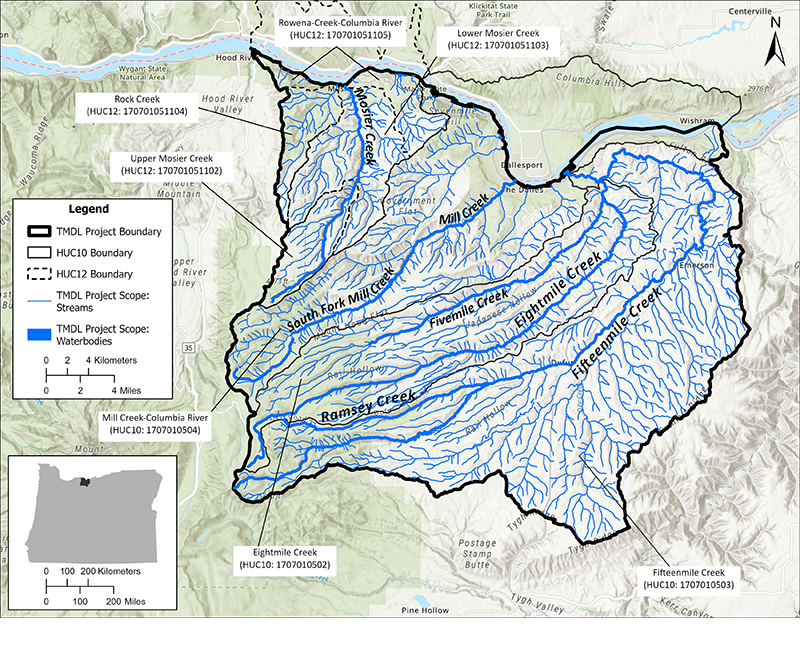
Project Area Map
Project summary
Monitoring data show temperatures for multiple streams in the project area watersheds are too warm for sensitive fish and do not meet Oregon's EPA approved temperature standards. As a result, the waters not meeting standards have been placed on a national list of impaired waters. The federal Clean Water Act requires states or EPA to develop a Total Maximum Daily Load, or TMDL, for each water listed as impaired. Once approved, the updated TMDL will replace the Middle Columbia-Hood (Miles Creeks) Subbasin temperature TMDL issued by DEQ in 2008 and approved by the United States Environmental Protection Agency on February 5, 2009.
DEQ is replacing the existing TMDL following the outcome from two court cases and related EPA actions. In response to a 2012 court decision, EPA disapproved Oregon's Natural Conditions Criterion for temperature in 2013, which had been used in most temperature TMDLs from 2003 through 2012. A 2019 court ruling then required DEQ and EPA to replace 15 TMDLs using the remaining approved parts of Oregon's temperature water quality standard.
Sign up for email updates on the TMDL Replacement Project web page.
A Total Maximum Daily Load is a water quality restoration plan and the calculation of the maximum amount of a pollutant that a waterbody can receive while still meeting water quality standards for that particular pollutant. The maximum amount of loading a waterbody can receive is called the loading capacity. Loading from all pollutant sources must not exceed the loading capacity of a waterbody, including an appropriate margin of safety.
Quality Assurance Project Plans: Middle Columbia-Hood (Miles Creeks) Subbasin
A Quality Assurance Project Plan is developed prior to writing the TMDL and does the following:
- Define the issue and objectives of the TMDL, including the spatial and temporal extents of the water quality impairments.
- Provide a high-level description of the key processes and variables for temperature.
- Outlines the overarching technical approach for the TMDL, including the appropriate modeling and analytical tools to be used.
- Provides the data sources for defining and creating inputs to the models, including data that were used in the modeling for the original TMDLs, if an original exists. Examples of these inputs can include meteorological data, stream flow and temperature, point sources and vegetation characteristics.
- Describes how the analysis and modeling will be evaluated for acceptability.
- Describes potential scenarios for evaluating management strategies for reducing anthropogenic thermal loads.
- Provides various aspects for managing the TMDL development project, including documentation, the project team, data, and records management.
Rulemaking
TMDL development and implementation is a public process. DEQ will develop this TMDL by rule per
Oregon Administrative Rule Chapter 340 Division 42. During a rulemaking process, DEQ seeks public involvement by holding public hearings, establishing rule advisory committee meetings for technical and policy input, and for feedback regarding potential fiscal impacts related to the rule.
Middle Columbia-Hood (Miles Creeks) Subbasin temperature TMDL rulemaking
DEQ will hold an informational webinar, two rule advisory committee meetings and a public hearing. DEQ will present the draft TMDL and Water Quality Management Plan to the Environmental Quality Commission, DEQ's formal policy and rulemaking body, for adoption before submitting the TMDL to EPA for approval or disapproval. Please visit the
rulemaking page for details and information how to participate.