The Origins of the TAPP Grant
After the release of
The Condition of Education for Members of Oregon's Indian Tribes in January 2013, a study from the Chalkboard Project, the Government to Government Education Cluster (comprised of representatives from each of the& nine federally recognized Tribes in Oregon) created a Policy Option Package (POP) to solicit state funding to reduce chronic absenteeism of American Indian/Alaska Native students. The study revealed if you were an American Indian/Alaska Native student nearly one-third (33%) in all grades were chronically absent (missing 10% or more of school days). While all other students are at less than one-fifth (19%) chronically absent.
The Oregon legislature set aside funds for the 2025-2027 to recieve $200,000 (TAPP expansion sites will receive $400,000) to operate TAPP projects focused on addressing the root causes of chronic absenteeism in ten Oregon school districts. TAPP will enable participating districts to fund a full-time TAPP Family Advocate position. This person has deep local connections and helps implement a balanced approach to improve attendance co-created by the school district and a tribal partner.
The intent of the collaboration is to strengthen the links between Oregon Tribes and the schools that serve any student identifying as American Indian/ Alaska Native (AI/AN), even if the student is not a member of a federally recognized tribe. TAPP differs from Title VI programs in that fundamental way. However, because this is a school-wide initiative, it will positively impact the attendance of every student attending TAPP schools.
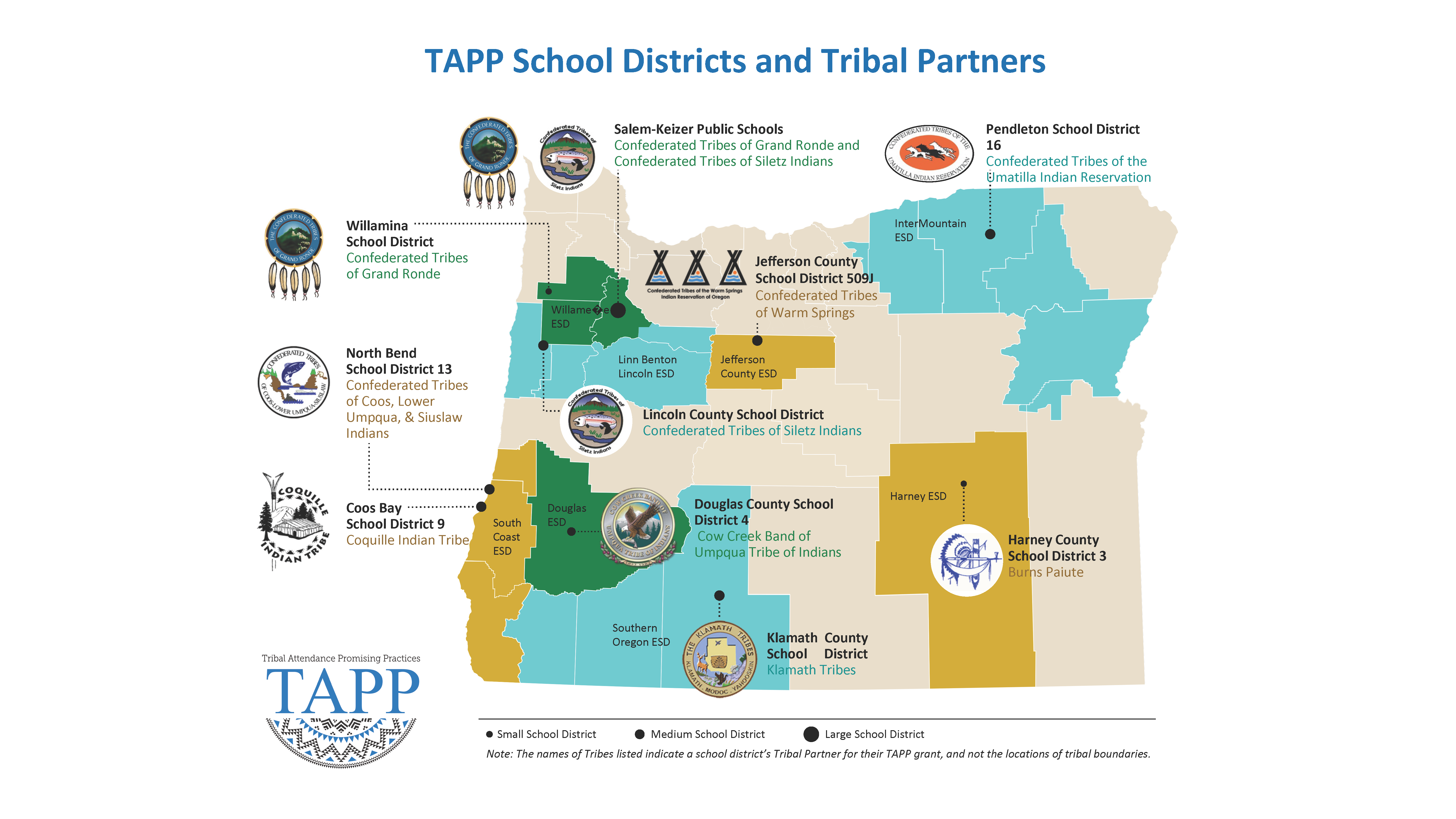
TAPP Sites
A common Pedagogy
TAPP Family Advocates have worked to define what it means to create a school-wide culture that is culturally responsive for AI/AN+ students. Not able to find a comprehensive national model to define this pedagogical approach, the TAPP Family Advocates studied the four foundational supports from Attendance Works which must be in place to create positive conditions for any student to learn.
Physical and Emotional Health and Safety
Belonging Connection and Support
Academic Challenge and Engagement
Adult and Student Well-Being and Emotional Competence
TAPP Family Advocates have worked to identify what these foundational supports in the four main domains look like in practice at each of their school sites for ALL students. It is important to know that this work went far beyond statements around “beliefs”, but sought to identify CONCRETE systems and structures in place in a school to tend to each category. TAPP Family Advocates then worked to “indigenize” each category. To indigenize means to root out biased systems and structures by becoming aware of, respecting, and incorporating indigenous perspectives and practices into these westernized systems, institutions, and structures.
For each of the four foundational supports, TAPP Family Advocates worked to identify what additional, but still foundational needs AI/AN+ students have in the four categories. This process is depicted in the graphics below and became our model - our TAPP pedagogy - for what it means to create a school culture that is culturally responsive to AI/AN+ students. We incorporated the medicine wheel as a visual reminder to “indigenize” each category.
Attendance Works Model -
Description: Four section vinn diagram: north circle "Physical and emotional health and Safety", east circle " belonging, Connection, and Support", South Circle " Academic Challenge and Engagement", West Circle " Adult and Student Well-being and Emotional Competence".
Attendance Works Model Adapted by the TAPP Family Advocates -
Image Description:Four section vinn diagram: north circle "Physical and emotional health and Safety", east circle " belonging, Connection, and Support", South Circle " Academic Challenge and Engagement", West Circle " Adult and Student Well-being and Emotional Competence". Around the four section vinn diagram "Foundational Supports to Creat a School Wide Culture that is Culturally Responsive to AI/AN+ Students"
Key Resources to Support TAPP Work
TAPP Promising and Best Practices Comprehensive Resource- This is our most comprehensive document for TAPP. It is a living document and is updated regularly throughout the school year.
TAPP Systems Weaving Framwork - This framework supports TAPP teams in translating deep conversations about root causes into coordinated, sustainable systems work that strengthens attendance, belonging, and student success.
Setting the TAPP Family Advocate Up for Success - Self Assessment -
This assessment is aligned to Section Two of the TAPP Promising and Best Practices Comprehensive Resource up above.
Culturally Responsive Tiered Attendance Systems - Self Assessment
This assessment is aligned to Section Four of the TAPP Promising and Best Practices Comprehensive Resource up above.
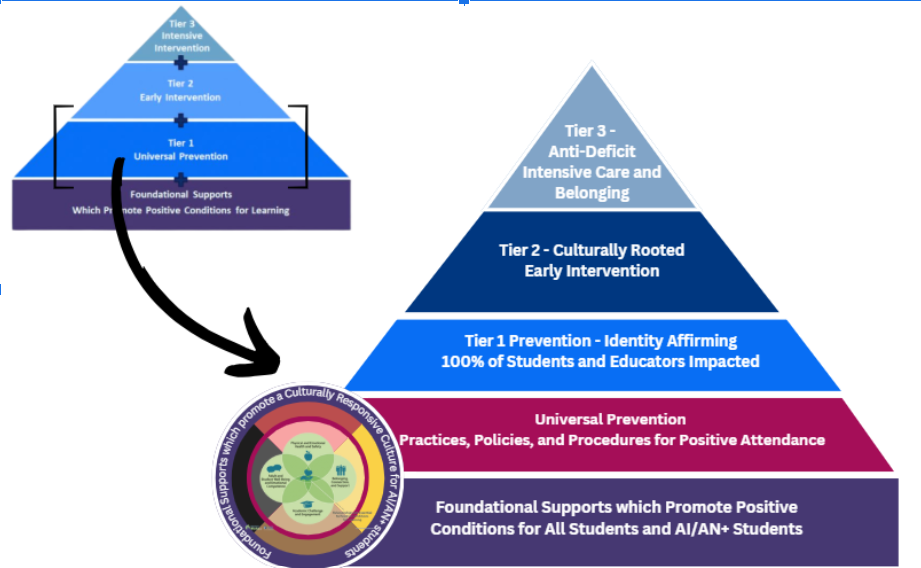
Image: The image compares two tiered intervention models in education. On the left is a basic pyramid showing four tiers: foundational supports, universal prevention, early intervention, and intensive intervention. An arrow points to an updated, culturally responsive model on the right. This new model includes five tiers: foundational supports for all students including AI/AN+ students, universal prevention practices for positive attendance, identity-affirming Tier 1 prevention for all students and educators, culturally rooted early intervention (Tier 2), and anti-deficit intensive care and belonging (Tier 3). A circular graphic at the base emphasizes foundational supports that promote a culturally responsive culture.
Attendance Works - Foundational Supports interview Questions - The Tribal Attendance Promising Practices program is built off of the research-based methods from Attendance Works. In our TAPP monthly meetings this year, we have been learning more about the Three Tiers of Intervention, especially about the importance of “Foundational Supports”.
For any TAPP Family Advocate or any support staff member who leads regular attendance efforts who would like to learn more about the foundational supports in place at their school, these interview questions can help guide them.
McKinney Vento, TAPP, and Title VI Indian Education Support Document
HB 3218 - The TAPP Expansion Study
House Bill 3218 (HB 3218), enacted during the 2025 legislative session, direct the Oregon Department of Education (ODE), in conjunction with the Legislative Commission on Indian Services (LCIS), to study opportunities to expand the Tribal Attendance Promising Practices (TAPP) program. Specifically, the legislation calls for examining:
- Increases in funding to enable the program to serve more students at existing program locations, and
- Increases in funding to facilitate the establishment of additional program locations throughout the state.
HB 3218 directs ODE to submit a report to the interim committees of the Legislative Assembly related to education, no later than September 15, 2026. This report includes a summary of the methodology, best practices, findings, and recommendations, including identifying any funding needed for implementation.
Trainings for TAPP Districts
Data Transparency
Please use the links below to review data submitted to ODE by school Districts
English Language Arts, Mathematics, and Science Assessment Reports** This link will also show you results from the Student Educational Equity Development Survey (SEED).
At-A-Glance School District Profiles
Regular Attenders (formerly "Not Chronically Absent") Report
Graduation and Dropout Rates
Oregon Statewide Report Card: 2022-2023
Discipline, Restraint and Seclusion Collections
Graduation Requirements and College Preparation
Additional Resources
Contact:
Stacy Parrish, Stacy.parrish@ode.oregon.gov